Why did my AWS bill suddenly increase?
10 mins read

Quick answer: Most sudden AWS bill jumps come from a short list. NAT gateway data processing. Data transfer. Runaway autoscaling. A forgotten test environment. CloudWatch logs. Snapshots piling up. A leaked key. Or credits that ran out. Open Cost Explorer, group by service, then by usage type. The cause shows up in minutes.
A sudden jump is not one big change. It is something small that runs for hours before anyone looks. Here are the usual suspects.
What are the most common causes of a sudden AWS bill increase?
Nine causes cover most real spikes.
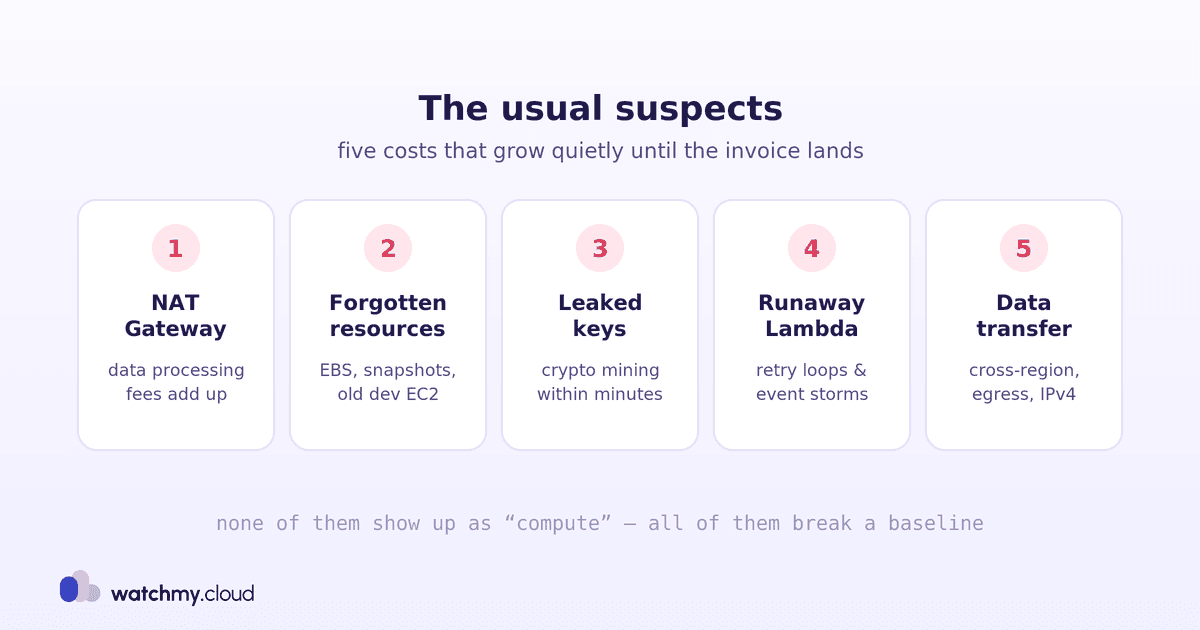
1. NAT gateway data processing. AWS bills every gigabyte through a NAT gateway. A retry storm can multiply this line overnight.
2. Data transfer. Cross-AZ, cross-region and internet egress all cost money. A new replication setup lands here.
3. Runaway autoscaling or stuck jobs. A job in a crash loop. A scaling group chasing a bad health check. A Lambda that triggers itself.
4. Forgotten environments. Last quarter's staging cluster, still running. Load balancers left behind after a teardown.
5. CloudWatch log ingestion. One new debug flag can push log costs past the compute that writes them.
6. Storage that keeps growing. EBS snapshots on a schedule nobody reviews. S3 buckets with no lifecycle rules. Old AMIs.
7. Traffic spikes and bots. Real users are good news. Scrapers hammering an expensive endpoint are not.
8. Compromised credentials. Someone finds a leaked key and launches big instances to mine crypto. Often in a region you never use.
9. Credits running out. Usage did not change. Credits were paying the bill. Now you are. Check this first if usage looks flat.
How do I find the cause in Cost Explorer?
Five minutes, five steps.
1. Open Cost Explorer. Set the range to the last 14 days and granularity to daily.
2. Group by Service. The line that jumps names your suspect. EC2. EC2-Other. CloudWatch. S3.
3. Select that service and group by Usage Type. Now the quiet lines get names. NatGateway-Bytes is NAT gateway processing. DataTransfer-Regional-Bytes is cross-AZ traffic. Log ingestion shows up on its own line too.
4. If your account has hourly granularity turned on, switch to hourly around the jump. AWS charges for it and keeps 14 days. The start hour names the deploy, cron job or incident.
5. Compare that start time against your deploy log and scaling events.
Spend in a region you never use? Treat it as a leak. Rotate the keys first. Investigate second.
The console can be wrong too. In July 2026 AWS showed inflated estimates and fired false alerts. It charged nobody. What happened.
Was it a rate change or a usage change?
Two different problems hide behind one bigger number.
Usage change. You consumed more. Quantities rise with the cost. Fix the workload.
Rate change. You paid more for the same. Credits expired. A Savings Plan lapsed. A free tier ended. Quantities stay flat, only cost moves. Fix the purchasing.
Cost Explorer shows quantities next to costs, so the answer takes one look. It saves you hunting a runaway service that never ran.
Who gets paged when your bill doubles?
Nobody at AWS. That is not a dig. It is how the incentives sit. AWS bills what you use. A quiet spike is your problem, and you meet it on the invoice.
That is why people find out too late. Most search for billing alerts after the incident, not before. A forgotten GPU instance runs about $3,000 a week. A leaked key buys a stranger two days of your compute. Then comes the shock. The money is already owed.
If you are reading this before that happened, you are early. Setting up alerts is a ten-minute job.
What can I set up to catch the next one?
AWS Budgets and AWS Cost Anomaly Detection come with your account. Both help. Both are slow, and both are yours to run.
Budgets updates up to three times a day, 8 to 12 hours apart. Anomaly Detection runs about three times a day, on data that lags up to 24 hours. A spike at 9 AM can wait until evening.
The work is manual too. You pick the budget and every threshold. You create an SNS topic, subscribe to it, confirm the subscription. Slack needs a separate Amazon Q Developer setup. When normal spend drifts, you re-tune the numbers. Nothing creates or updates itself.
An email in a busy inbox is not enough here either. A spike is a to-do, not a newsletter.
How does watchmy.cloud help here?
Connect AWS. Read-only billing access. No keys. No access to what you run. One CloudFormation template, about two minutes.
Send it where work happens. Slack for fast triage. Jira for follow-up. API when you want control. Email, SMS and GitHub Issues as well.
Stop worrying about it. We watch AWS spend for you, so you don't have to keep checking it.
After the connect it runs automagically. We read hourly Cost Explorer data and learn what normal looks like. One dial, 1 to 5, sets how sensitive the anomaly rules start. Tune any rule by hand from there. A flat $49 a month.
Watching AWS spend is our full-time job. You focus on your product — and sleep well.
FAQ
Why is my AWS bill so high with no usage change?
Check for a rate change first. Promotional credits expired, a Savings Plan or Reserved Instance lapsed, or the free tier ended. In Cost Explorer, flat usage quantities under a rising cost confirm it.
What is "EC2-Other" in my bill?
A catch-all Cost Explorer group. It holds NAT gateway processing, EBS volumes and snapshots, and data transfer. Three of the quietest spike sources. Group by usage type to split it.
How do I check if my AWS account was hacked and is mining crypto?
Look for EC2 spend in regions you don't use and large GPU or compute types you never launch. If you find it: rotate every access key, terminate the instances, open an AWS support case.
Does AWS warn me before the bill arrives?
Only if you set that up first. AWS Budgets needs thresholds you pick. Cost Anomaly Detection needs a monitor you configure. Anything past email needs an SNS topic and a confirmed subscription.
How fast can I get alerted about an AWS cost spike?
AWS-native tools read daily data and check about three times a day. You hear about it the same day or the next one. Tools that read hourly Cost Explorer data, like watchmy.cloud, alert about an hour after the spike lands in the data.

More


